From cosplay to hentai sub-culture, Japan has it all. But a cult running for the elections? I've to admit I didn't see that coming.
I first heard of it yesterday when I was on my way back from my grocery shopping. They had a van running around in the neighbourhood. The loudspeaker played the same message ad nauseum, breaking the ennui of a lazy summer afternoon. But when your brain has gotten used to the yaki-imo vans and the recycling trucks, it doesn't take any effort to ignore loudspeaker vans of other sorts.
The candidate running for the general elections waved at the passerby's, "Yoroshiku onegaishimasu!"
Not that I'll get to vote this August 30. But so as not to appear rude, I smiled and nodded at her. That's when I caught a glimpse at the name - Happiness Realization Party.
Showing posts with label Angry Bunnies. Show all posts
Showing posts with label Angry Bunnies. Show all posts
Tuesday, 4 August 2009
Saturday, 11 July 2009
Flip Flop Policy
Posted in:
Angry Bunnies
| 3
persons flung their shoes
I hate resorting to harsh language but I'm not going to hold back my anger towards a stupid decision made by the Malaysian government. The idiocy of Malaysian policymakeres knows no bounds. If you follow the Malaysian news, you'd believe the country is run by a bunch of imbeciles.
I can't believe this is happening. The government has decided to end the use of English in Science and Math teaching, reverting to the national language as the medium of teaching. This issue has been at the center of debate for some time now but to think that it would actually get through the parliament was the last thing I expected.
When Tun Dr Mahathir called for the teaching of Science and Math in English six years ago, it was in line with one of the nine challenges of Vision 2020 - "to form a progressive science community". It is believed that the people should embrace English as the international language in order to make themselves a competent nation. While there were issues to be addressed, the idea was lauded as a bold move that will benefit the country in the long term.
Unfortunately, some brainless scarecrows in the parliament have just made a stupid decision to undo the previous efforts. The teaching medium of Science and Technology is going to be reverted to the national language in 2012. Supposedly, the achievement of Malaysian students in the subjects has been at a steady decline since English was introduced in 2003. It has therefore prompted the government to make the decision to switch the teaching medium. But if you ask me, it seems more like a desperate political move to regain support from the Malay nationalists.
Our dear MP from Kulim, Zulkifli Noordin, is an example of our diehard nationalist who's relentlessly fought to defend the pride of the national language. Using English in schools is seen as a threat to Bahasa Malaysia, which is the integral part of Malay heritage. Two days ago, he made a comment on his blog, saying, "English proficiency does not guarantee scientific progress". Oh, as if using Bahasa Malaysia as the language of instruction is a better shot.
Our narrow-minded guy didn't just stop there. Instead, he went on bashing Tun Dr Mahathir for the policy, which he claimed deters the students' achievement. He then went on making some sweeping statements.
Quoted from his blog post (translated):
"People in the Philippines are proficient in English, but many landed up only as maids. The Philippines took pride in their peoples' ability to speak English but had only succeeded in exporting many maids, whereas Japan has produced many international award-winning scientists who could not even utter a word of English."
When I first came to Japan, I, too, wondered why the Japanese can be such a progressive nation despite the pathetic level of English. It appears that the Japanese can afford not to master English, although it is the language of knowledge. Japanese academic books can be found easily; newly-published English books are often translated into Japanese within weeks if not days. Meanwhile, in Malaysia, how often do you find academic texts in Bahasa Malaysia? Even the local reference books I used to read weren't reliable.
Looking at the English syllabus in Japanese schools, it's hard to believe that the students here are learning English in much more detail than we do in Malaysia. But I can safely bet that the average Malaysian can understand English better than the Japanese. This is because of we are exposed to the opportunity to actually speak the language instead of learning just the grammar rules. Using English as the medium of instruction was the right move to make. Increasing English lessons in schools will never compensate for the damage that is going to be done by the abolishment of the use of English.
Am I disappointed? No, I'm furious.
If you're curious about what Tun Dr Mahathir has to say, head over to his blog. (The post is in Bahasa Malaysia.)
I can't believe this is happening. The government has decided to end the use of English in Science and Math teaching, reverting to the national language as the medium of teaching. This issue has been at the center of debate for some time now but to think that it would actually get through the parliament was the last thing I expected.
When Tun Dr Mahathir called for the teaching of Science and Math in English six years ago, it was in line with one of the nine challenges of Vision 2020 - "to form a progressive science community". It is believed that the people should embrace English as the international language in order to make themselves a competent nation. While there were issues to be addressed, the idea was lauded as a bold move that will benefit the country in the long term.
Unfortunately, some brainless scarecrows in the parliament have just made a stupid decision to undo the previous efforts. The teaching medium of Science and Technology is going to be reverted to the national language in 2012. Supposedly, the achievement of Malaysian students in the subjects has been at a steady decline since English was introduced in 2003. It has therefore prompted the government to make the decision to switch the teaching medium. But if you ask me, it seems more like a desperate political move to regain support from the Malay nationalists.
Our dear MP from Kulim, Zulkifli Noordin, is an example of our diehard nationalist who's relentlessly fought to defend the pride of the national language. Using English in schools is seen as a threat to Bahasa Malaysia, which is the integral part of Malay heritage. Two days ago, he made a comment on his blog, saying, "English proficiency does not guarantee scientific progress". Oh, as if using Bahasa Malaysia as the language of instruction is a better shot.
Our narrow-minded guy didn't just stop there. Instead, he went on bashing Tun Dr Mahathir for the policy, which he claimed deters the students' achievement. He then went on making some sweeping statements.
Quoted from his blog post (translated):
"People in the Philippines are proficient in English, but many landed up only as maids. The Philippines took pride in their peoples' ability to speak English but had only succeeded in exporting many maids, whereas Japan has produced many international award-winning scientists who could not even utter a word of English."
When I first came to Japan, I, too, wondered why the Japanese can be such a progressive nation despite the pathetic level of English. It appears that the Japanese can afford not to master English, although it is the language of knowledge. Japanese academic books can be found easily; newly-published English books are often translated into Japanese within weeks if not days. Meanwhile, in Malaysia, how often do you find academic texts in Bahasa Malaysia? Even the local reference books I used to read weren't reliable.
Looking at the English syllabus in Japanese schools, it's hard to believe that the students here are learning English in much more detail than we do in Malaysia. But I can safely bet that the average Malaysian can understand English better than the Japanese. This is because of we are exposed to the opportunity to actually speak the language instead of learning just the grammar rules. Using English as the medium of instruction was the right move to make. Increasing English lessons in schools will never compensate for the damage that is going to be done by the abolishment of the use of English.
Am I disappointed? No, I'm furious.
If you're curious about what Tun Dr Mahathir has to say, head over to his blog. (The post is in Bahasa Malaysia.)

Saturday, 6 June 2009
False Conviction
Posted in:
Angry Bunnies
| 1 persons flung their shoes
In the world of CSI and Bones, there's no unsolved crime, no bad guy goes unpunished. But unfortunately, in the real world, that's not how things work.
Imagine suddenly being taken away by the police for an interrogation, where you're forced to make a confession on a crime you've not committed. Then before you know what happened, you're chucked into a prison to spend the rest of your life there.
That actually happened to a guy from Tochigi. He was "convicted" of the murder of a 4-year-old girl. The 62-year-old was released yesterday, after DNA tests came back with a negative result. It's more than good to be a free man again after spending the last 18 years in prison for false charges.
18 freaking years of life, gone. So many things can happen in 18 years' time. 18 years ago, George Bush Senior was the president of the United States. 18 years ago, Michael Jackson was the King of Pop. And 18 years ago, we couldn't tell apart simian DNA from that of a homo sapien's.
The chances of a coincidental match back then was about 1 to 700, which was considerably high. That was how the man got convicted. But what's more unacceptable is that during the investigation, the man was roughed up and coerced to make a confession.
The press conference was in the news the other day. During the session, the man appeared calm but when he spoke about the forced confession, he couldn't hold back his anger.
"The police will not be forgiven." For a man who has lost 18 years of freedom, that can be naturally understood. He has lost much, including his parents who passed away while he was in prison.
It's scary to know that when we're expecting law enforcers to protect us, innocent men are actually convicted of false charges. Who knows how many others are there? And it can happen to just about anyone.
News articles:
DNA test findings lead to lifer's release
『警察、検察許せぬ』 釈放の菅家さん 語気強め捜査批判
足利事件:菅家さん「謝って」 記者へ手紙
Imagine suddenly being taken away by the police for an interrogation, where you're forced to make a confession on a crime you've not committed. Then before you know what happened, you're chucked into a prison to spend the rest of your life there.
That actually happened to a guy from Tochigi. He was "convicted" of the murder of a 4-year-old girl. The 62-year-old was released yesterday, after DNA tests came back with a negative result. It's more than good to be a free man again after spending the last 18 years in prison for false charges.
18 freaking years of life, gone. So many things can happen in 18 years' time. 18 years ago, George Bush Senior was the president of the United States. 18 years ago, Michael Jackson was the King of Pop. And 18 years ago, we couldn't tell apart simian DNA from that of a homo sapien's.
The chances of a coincidental match back then was about 1 to 700, which was considerably high. That was how the man got convicted. But what's more unacceptable is that during the investigation, the man was roughed up and coerced to make a confession.
The press conference was in the news the other day. During the session, the man appeared calm but when he spoke about the forced confession, he couldn't hold back his anger.
"The police will not be forgiven." For a man who has lost 18 years of freedom, that can be naturally understood. He has lost much, including his parents who passed away while he was in prison.
It's scary to know that when we're expecting law enforcers to protect us, innocent men are actually convicted of false charges. Who knows how many others are there? And it can happen to just about anyone.
News articles:
DNA test findings lead to lifer's release
『警察、検察許せぬ』 釈放の菅家さん 語気強め捜査批判
足利事件:菅家さん「謝って」 記者へ手紙
Monday, 20 April 2009
Religion and Social Dysfunction
Posted in:
Angry Bunnies
| 0
persons flung their shoes
In the news this evening was a special interview with a former member of The Holy Spirit Association for the Unification of World Christianity. It's a "Christian sect" started in South Korea but is not recognized by the Church. In fact, it's often referred to as a cult. Despite the controversies shrouding it, the movement is active around the world, especially in South Korea and Japan. In the interview, the lady claimed to have been conned of at least 3 million Yen. But there're reports from victims who supposedly paid as much as 10 million Yen to the "church".
Obviously cults are detrimental to the society. They make you part with your money and family, they require you to pledge absolute commitment to the cult. But how many of us actually think for a moment if religion actually does much good to us? It's a common belief that religion is beneficial. Advocates are steadfast in view that the belief in supernatural presence is critical to the development of a stable society.
Embarassingly, as Malaysians, this very stereotypical view is firmly embedded in our head. I'm sure skmming through any essay written by a Malaysian student can confirm this. Whenever we're asked to discuss about social problems, we immediately point to the lack of religious faith as one of the underlying factors.
But check this out. According to a study made by Gregory S. Paul, "the most religious democracies exhibited substantially higher degrees of social dysfunction than societies with larger percentages of atheists and agnostics." (Excerpt from Los Angeles Times: The Dark Side of Faith, October 01, 2005)
Inarguably, there's no way to come up with a definitive conclusion but at least the result will hopefully encourage further debate on the matter. People should be aware that religion is no holy issue which should be, by default, spared from scrutiny. Because, like it or not, religion plays a big role in the formation of both government and judicial policies. Think about the laws on abortion, gene therapy, cloning, stem cells research... They are made based on the standards set by religion, presumed to be the default public consensus. Believers or not, we are all dictated by religious dogmas. How then, can laxity towards religion be tolerated?
See also:
"Religion is Bad for Societal Health" - Church of the Churchless
Testimonial of a former member of the Unification Church (Japanese)
Legal complaints filed by fraud victims of the Unification Church (Japanese)
Obviously cults are detrimental to the society. They make you part with your money and family, they require you to pledge absolute commitment to the cult. But how many of us actually think for a moment if religion actually does much good to us? It's a common belief that religion is beneficial. Advocates are steadfast in view that the belief in supernatural presence is critical to the development of a stable society.
Embarassingly, as Malaysians, this very stereotypical view is firmly embedded in our head. I'm sure skmming through any essay written by a Malaysian student can confirm this. Whenever we're asked to discuss about social problems, we immediately point to the lack of religious faith as one of the underlying factors.
But check this out. According to a study made by Gregory S. Paul, "the most religious democracies exhibited substantially higher degrees of social dysfunction than societies with larger percentages of atheists and agnostics." (Excerpt from Los Angeles Times: The Dark Side of Faith, October 01, 2005)
Inarguably, there's no way to come up with a definitive conclusion but at least the result will hopefully encourage further debate on the matter. People should be aware that religion is no holy issue which should be, by default, spared from scrutiny. Because, like it or not, religion plays a big role in the formation of both government and judicial policies. Think about the laws on abortion, gene therapy, cloning, stem cells research... They are made based on the standards set by religion, presumed to be the default public consensus. Believers or not, we are all dictated by religious dogmas. How then, can laxity towards religion be tolerated?
See also:
"Religion is Bad for Societal Health" - Church of the Churchless
Testimonial of a former member of the Unification Church (Japanese)
Legal complaints filed by fraud victims of the Unification Church (Japanese)
Sunday, 21 December 2008
Denouncing Internet Explorer
Posted in:
Angry Bunnies
| 4
persons flung their shoes
If you're having problems viewing this blog - awkwardly aligned pictures, strange margins etc - chances are you belong to the shrinking population of Internet Explorer users. While I feel obliged to cater to the needs of all potential readers, I'm quickly running out of patience tweaking the template to run properly in IE. Earlier, it took me two frustrating hours before I eventually got the layouts of the div components right. Now, I'm having problems with the alignment of images.
Alright. That was the last straw. I hereby pronounce this blog IE-unfriendly!
IE is a major headache for all web developers. (No wonder the folks call it "the cancer of the web".) Even the pros are having a tough time with IE, not to say an amateur like me. I'm totally a PHP illiterate; neither can I perform fancy magic with JavaScript and XML. The only trick I've got up the sleeves is CSS. Unfortunately, IE is as much a retard in CSS as I am in art. Especially when you're dealing with the margins and paddings of div components, IE can be very cantankerous. Of course, it's possible to work around those problems - ironically - by utilizing IE bugs , but why take the trouble, I say.
The design of a website depends on the target audience. All this while, I've strictly kept my blog to 800 pixels wide for the sake of those with low-resolution monitors. But check out this latest statistics provided by W3school. While they may not be 100% realistic figures, they at least give you an image of it.

Obviously, more than 90% of the computers nowadays have at least a 1024x768-pixel display. That's why I set this blog at 1000 pixels wide. Now my blog can afford to spare a bigger piece of the real estate for the photos I intend to post.
Now, check out the browser statistics.
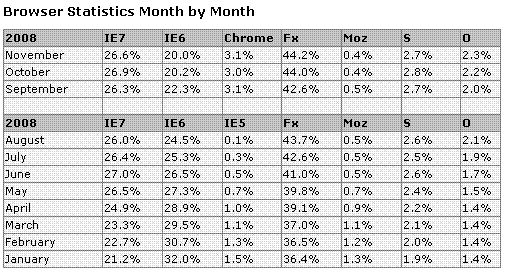
As you can see, both Firefox and IE share almost the same size of the pie. But there's a steady trend in the dropping percentage of IE users - down by about 10% compared to last year. I guess that justifies my decision to stop wasting my time tweaking my template to suit IE.
Alright. That was the last straw. I hereby pronounce this blog IE-unfriendly!
IE is a major headache for all web developers. (No wonder the folks call it "the cancer of the web".) Even the pros are having a tough time with IE, not to say an amateur like me. I'm totally a PHP illiterate; neither can I perform fancy magic with JavaScript and XML. The only trick I've got up the sleeves is CSS. Unfortunately, IE is as much a retard in CSS as I am in art. Especially when you're dealing with the margins and paddings of div components, IE can be very cantankerous. Of course, it's possible to work around those problems - ironically - by utilizing IE bugs , but why take the trouble, I say.
The design of a website depends on the target audience. All this while, I've strictly kept my blog to 800 pixels wide for the sake of those with low-resolution monitors. But check out this latest statistics provided by W3school. While they may not be 100% realistic figures, they at least give you an image of it.
Obviously, more than 90% of the computers nowadays have at least a 1024x768-pixel display. That's why I set this blog at 1000 pixels wide. Now my blog can afford to spare a bigger piece of the real estate for the photos I intend to post.
Now, check out the browser statistics.
As you can see, both Firefox and IE share almost the same size of the pie. But there's a steady trend in the dropping percentage of IE users - down by about 10% compared to last year. I guess that justifies my decision to stop wasting my time tweaking my template to suit IE.
Subscribe to:
Posts (Atom)